
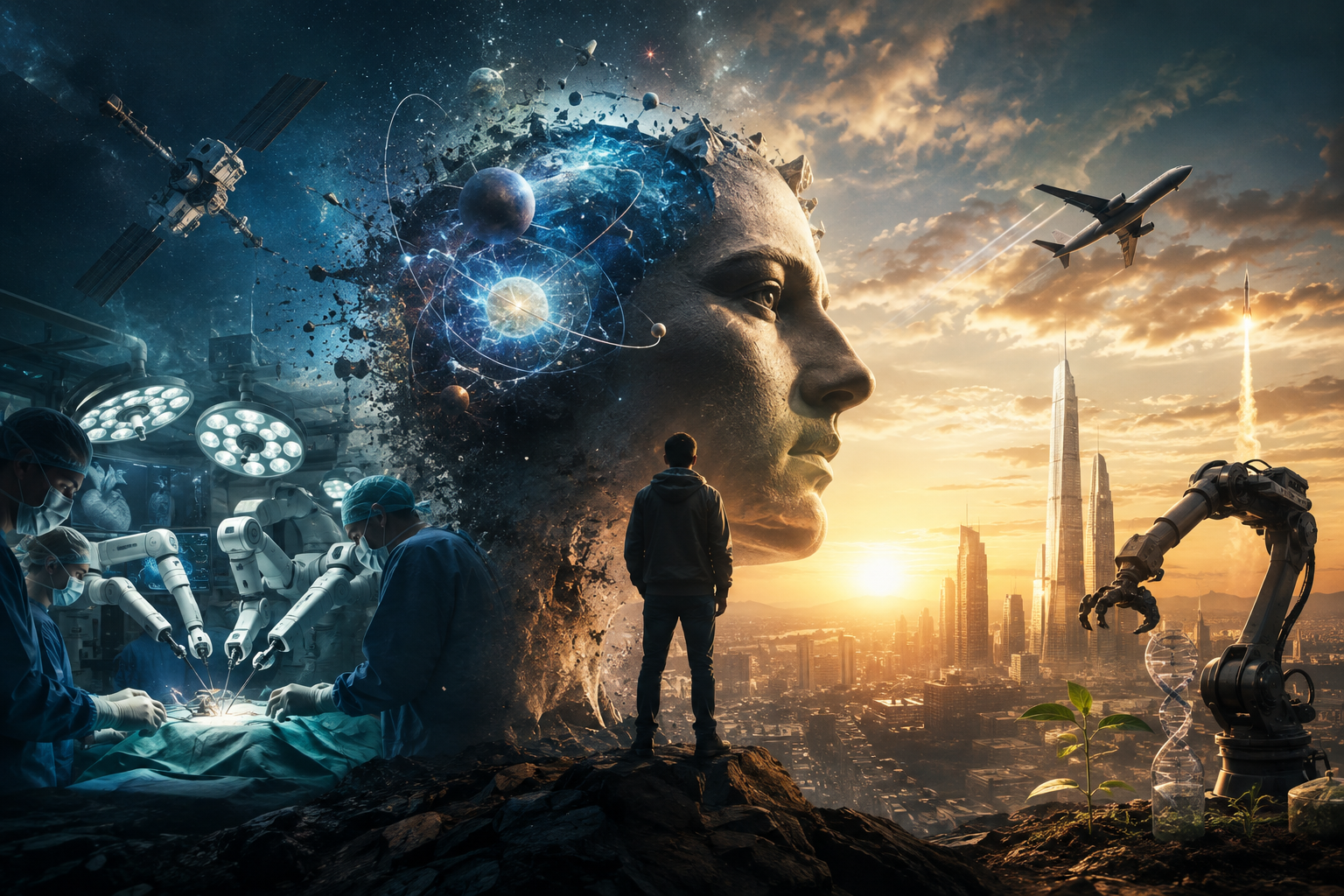
I have come to the realization that things I once thought were impossible are actually possible.
And the more I think about it, the more strange it becomes.
Growing up, there were many things I simply accepted as God's work. Not because I had investigated them deeply, but because they were beyond the ability of a human being to explain, let alone reproduce. The human body, life itself, the weather, the stars, disease, birth, death, the movement of the planets — these were things that seemed to belong to a category far above us.
And I think that is how most human beings throughout history experienced the world. If you lived a thousand years ago and watched someone become seriously ill and then watched another person somehow open their body, remove something, repair something, replace something and close them back up, you probably wouldn't call that medicine. You would probably call it magic. You might call the person a god. There would be no other frame of reference.
But today, we do things like this routinely.
And somehow, because we have become used to them, we don't stop to appreciate how insane they actually are.
Take surgery.
There was a time when opening the human body was almost a death sentence. There were no modern anaesthetics, no antibiotics, no advanced imaging, no blood banks, no understanding of infection and no sophisticated way of controlling bleeding. A surgeon could cut into you and still have very little understanding of what was happening inside.
Today, a surgeon can look at a human body, identify a diseased organ, make a plan using detailed scans, make tiny incisions, insert cameras and instruments, operate inside the body and remove or repair tissue without making the enormous cuts that were once necessary.
And we went even further.
We started building machines that help surgeons operate.
Robotic surgery is not some science-fiction concept waiting for the future. Robots have already been used in human surgery for decades. The first robotic system used on a human patient performed a neurosurgical biopsy in 1985, and modern systems can give surgeons magnified three-dimensional views, highly precise instruments, motion scaling and tremor filtering.
Think about what that actually means.
A human being can sit at a console and control robotic instruments inside another human body.
The machine can translate the surgeon's movements into extremely precise movements.
The surgeon doesn't have to put their hands directly inside the body.
They can manipulate instruments through tiny openings while looking at an enlarged three-dimensional image of what they are doing.
And we call this an operation.
There is something almost absurd about how normal that sentence has become.
But surgery becomes even more unbelievable when you think about transplantation.
Humans discovered that a failing organ does not necessarily have to mean the end of a person's life. We learned that an organ can come from another human being and be placed inside someone else. The first successful human kidney transplant was performed in 1954 between identical twins. Since then, transplantation has expanded to kidneys, hearts, lungs, livers and other tissues, with modern immunosuppressive medicine making it possible for transplanted organs to survive in people who otherwise would have died from organ failure.
We can literally take a heart out of one human being and put it inside another.
We can take a liver from one person and transplant it into another.
We can remove a kidney from a living person and give it to somebody whose kidneys no longer work.
We can transplant hands.
We can transplant faces.
We have even reached the point where researchers are working on laboratory-grown organs and increasingly sophisticated tissue engineering.
Just stop and think about the concept.
You were born with a body.
Something inside that body begins to fail.
Another human being dies, or voluntarily gives part of their body, and doctors take that biological material, preserve it, transport it, match it, implant it into you and use medicine to convince your immune system not to destroy it.
You wake up with another person's organ keeping you alive.
What would someone from ancient civilization have called that?
I honestly don't know.
Then there is the fact that we can see inside you without opening you.
We can put someone inside a machine and produce images of what is happening inside their body. We can identify tumours, examine blood vessels, observe organs and construct detailed representations of structures that are completely hidden from our eyes.
Humans spent thousands of years looking at the outside of the body and guessing what was happening inside.
Now we can look through it.
And then there is something even stranger.
We started operating at a level smaller than the human eye can properly appreciate.
We learned that diseases can come from organisms too small to see. We discovered bacteria and viruses. We developed microscopes. We learned about cells. We learned that the human body is made of trillions of tiny living units, each carrying out incredibly complicated processes.
Then we went deeper.
We discovered DNA.
And eventually we learned how to read it.
Not perfectly. Not completely. But enough to begin changing it.
Modern genome-editing technologies can add, remove or alter specific sections of DNA. Human genome editing has already been investigated and used in somatic cells for conditions including sickle-cell disease, while scientists continue to work out what should and should not be possible with increasingly powerful genetic technologies.
This is where I sometimes think the word science hides how extraordinary what we are doing actually is.
Because saying "genome editing" makes it sound like another technical procedure.
But what we are actually talking about is this:
Humans have learned how to alter some of the instructions that make a human being.
We are looking at the biological code written inside our cells and learning how to modify parts of it.
We didn't create life.
But we are learning how to interfere with its instructions.
And then I start thinking about the weather.
Because for most of human history, weather was something you simply accepted.
If it rained, it rained.
If there was drought, you suffered.
If a storm came, there was very little you could do except hide from it.
Farmers watched the sky because the sky controlled their lives.
Entire civilizations could be affected by whether the rain came at the right time.
Today, humans can at least influence some atmospheric processes.
Cloud seeding involves introducing tiny particles, commonly silver iodide, into suitable clouds to encourage the formation of precipitation. It has been used for decades, and governments and organizations continue to operate or study such programs. The important catch is that we cannot simply look at a clear sky and order it to rain. Suitable clouds have to exist, and the actual increase in precipitation is difficult to measure reliably.
But even with that limitation, the idea is remarkable.
We looked at clouds and asked:
Can we interfere with this?
And instead of accepting the weather as something completely outside our control, we began experimenting with ways to influence it.
We even tried to modify hurricanes.
The United States once ran Project STORMFURY, an experimental program that attempted to weaken hurricanes through cloud seeding. The program eventually failed to demonstrate that humans could reliably weaken hurricanes, and later research showed that some of the observations that had encouraged the idea could occur naturally.
And strangely, I don't think the failure makes the story less impressive.
It makes it more impressive.
Because humans looked at one of the most powerful forces on Earth and thought:
Can we change it?
We were wrong about how to do it.
But we tried.
That seems to be one of the defining characteristics of humanity.
We see something enormous and instead of simply accepting it, we start asking questions.
Can we fly?
Can we go faster?
Can we see farther?
Can we live longer?
Can we replace a heart?
Can we repair a brain?
Can we alter DNA?
Can we predict an earthquake?
Can we influence rain?
Can we leave Earth?
Can we create another form of intelligence?
And every time we answer one question, another ten appear.
Look at space.
For almost all of human existence, the stars were things we could only look at.
They were lights in the sky.
We created stories about them.
We worshipped them.
We used them for navigation.
We wondered what they were.
Then we built telescopes.
Then better telescopes.
Then enormous observatories.
Then we built machines capable of leaving Earth.
Humans have sent spacecraft to other planets. We have landed machines on Mars. We have sent probes so far away that they have crossed the boundary between our immediate planetary neighbourhood and interstellar space.
And perhaps one of the strangest things we have ever built is a machine capable of looking so far into space that it is effectively looking into the past.
Because light takes time to travel.
When we look at distant galaxies, we aren't seeing them exactly as they are now.
We are seeing them as they were when that light began its journey.
So humans built machines that allow us to look billions of years into the history of the universe.
Think about that.
We are creatures that evolved on one planet, yet we have built instruments capable of observing events that happened billions of years before we existed.
There is something almost ridiculous about that.
And then we built computers.
Then the internet.
Then smartphones.
And now artificial intelligence.
A person sitting alone in a room can communicate with almost anyone on Earth, access an enormous portion of humanity's accumulated knowledge, translate languages, generate images, analyse documents, write software and interact with systems capable of processing information at a scale no individual human brain could handle.
We have effectively created extensions of our own minds.
And I think this is where the whole thing starts becoming uncomfortable.
Because if you take away the familiarity of modern life, what are we actually looking at?
We are looking at an animal that learned how to manipulate matter.
An animal that learned how to generate electricity.
An animal that learned how to split atoms.
An animal that learned how to fly.
An animal that learned how to leave its planet.
An animal that can replace parts of its own body.
An animal that can modify its own genetic material.
An animal that can influence atmospheric processes.
An animal that can build machines to see farther than its natural eyes can see.
An animal that can build machines to hear things it cannot naturally hear.
An animal that can build machines to calculate things it cannot calculate.
An animal that can create another machine and ask that machine questions.
And somehow, this animal is us.
Maybe that is what I failed to understand when I was younger.
I used to think of humanity as something small.
Just people.
People walking around.
People going to work.
People getting sick.
People being born and dying.
But when you look at humanity collectively, over thousands of years, it becomes something completely different.
One person discovers something.
Another person improves it.
Someone else combines it with another discovery.
Another generation builds on top of it.
And eventually, something that would have been considered supernatural becomes a normal Tuesday afternoon.
That may be the most extraordinary thing about human beings.
We inherit the impossible and turn it into infrastructure.
Someone once had to imagine a machine that could fly.
Now airports are everywhere.
Someone once had to imagine communicating without physically being together.
Now children complain when Wi-Fi stops working.
Someone once had to imagine replacing a human organ.
Now transplant medicine is a major field of medicine.
Someone once had to imagine machines performing surgery.
Now robotic surgery is a real clinical technology.
Someone once had to imagine altering DNA.
Now genome editing is an actual scientific and medical technology.
Someone once looked at clouds and wondered whether humans could influence rainfall.
Now cloud seeding is a real, if limited and scientifically complicated, form of weather modification.
And this makes me wonder about the things we currently call impossible.
How many of them are actually impossible?
And how many are simply things we haven't figured out yet?
Because history gives us a very uncomfortable answer.
We are terrible at knowing where the limits of human ability actually are.
Again and again, humans have drawn a line around what they thought could not be done.
And then somebody crossed it.
Maybe humans are not gods.
Maybe we are nowhere near what a god would actually be capable of.
But if that is true, then there is another question I find even more interesting.
Why do we keep becoming capable of things that previous generations would have considered divine?
I don't think I have an answer.
But I think about it every time I see a plane in the sky.
Every time I make a video call with someone thousands of kilometres away.
Every time I see a surgical procedure that would have been unimaginable a few centuries ago.
Every time I hear about an organ transplant.
Every time I see an image from deep space.
Every time I use artificial intelligence.
Every time I realize that inside my own cells is a biological code that humans are slowly learning how to read and modify.
Maybe we have become so accustomed to our inventions that we have forgotten to be amazed by them.
Maybe the modern human being is living inside a world that would have looked like heaven, magic or the realm of the gods to almost every person who lived before us.
And the strangest part is that we are still building.
We are still experimenting.
We are still discovering.
We still don't know what matter ultimately is, what consciousness really is, how life began, what most of the universe is made of, whether life exists elsewhere, or what the full limits of intelligence and biology might be.
So perhaps the most frightening thought isn't that humans might be gods.
It is that we have no idea what humans might eventually become capable of.
Because if history is any indication, the things we currently consider impossible may simply be waiting for someone to understand them.
And when that happens, the impossible will become ordinary again.
Just like everything else.



Leave a comment